THE BIOLOGY NOTEBOOK · 01
What can ancestry tell us about food?
Family recipes, the places we live, and biological inheritance. Three threads to follow with different kinds of evidence.
begin with a question
Source-based reading · Collection updated October 25, 2026
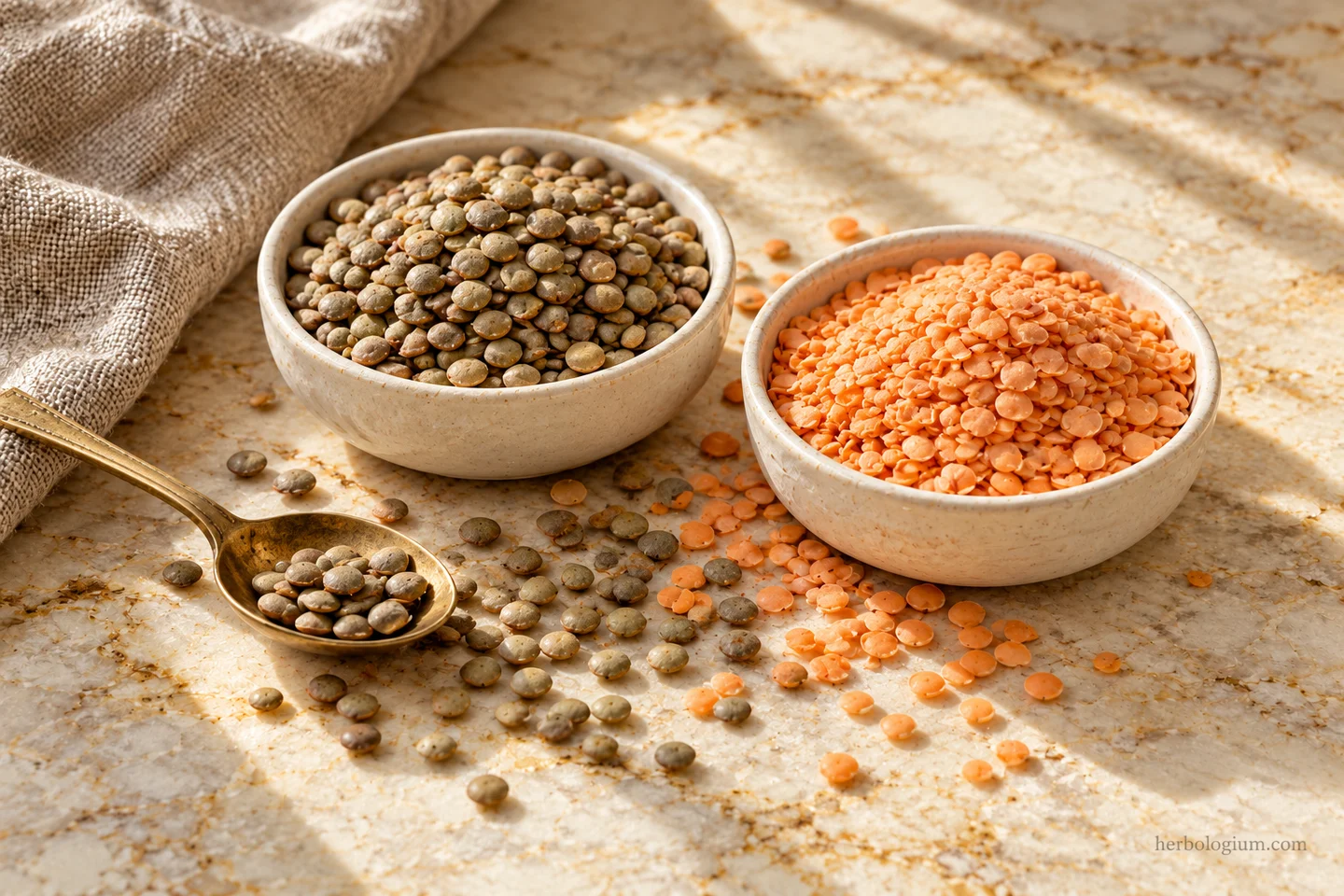
Lentil — imagined ingredient study · OpenAI image generation · Herbologium art direction. Original AI-generated ingredient illustration, made for Herbologium with Taj Mahal quartzite, flax linen and soft natural-light styling. Not a photograph, botanical identification guide, or documentation of a historical custom. The domain mark identifies the collection; no human photographer is claimed. No blanket reuse license is stated. Source: https://herbologium.com/botanical-illustrations.json
01 / FOLLOW THE QUESTION
What do we mean by inheritance?
Use these three lenses to frame a question. They overlap in a life; they do not add up to a genetic menu.
STEP 01
What was passed down?
Begin with people and practices: who taught a recipe, who recorded it, and how it changed. A family memory can tell us about belonging without establishing a biological effect.
Read all three steps
What was passed down?
Begin with people and practices: who taught a recipe, who recorded it, and how it changed. A family memory can tell us about belonging without establishing a biological effect.
What shaped the table?
Ask where and when the food was prepared, what was available, and what changed. These are prompts for reading a food history, rather than claims about a particular community.
Which response was studied?
NIH's precision-nutrition program examines genes alongside metabolism, the microbiome and individual circumstances. A research aim is different from a validated eating prescription.
Source for this step
The complete explanation
What was passed down?
Begin with people and practices: who taught a recipe, who recorded it, and how it changed. A family memory can tell us about belonging without establishing a biological effect.
What shaped the table?
Ask where and when the food was prepared, what was available, and what changed. These are prompts for reading a food history, rather than claims about a particular community.
Which response was studied?
NIH's precision-nutrition program examines genes alongside metabolism, the microbiome and individual circumstances. A research aim is different from a validated eating prescription.
References are listed under “Behind the explanation.”
02 / READ A LITTLE CLOSER
Several kinds of inheritance
Food inheritance includes biological ancestry, family recipes, cultural belonging, and the ingredients available where people lived. These threads can meet in a meal, but each calls for a different kind of evidence.
What the research asks
NIH's Nutrition for Precision Health program studies genes alongside metabolism, the microbiome, diet, and individual circumstances. Its aims concern better prediction; they do not establish that an ancestry category already supplies a complete menu.
A useful boundary
In the DIETFITS randomized trial of 609 adults, the genetic pattern tested did not identify who would lose more weight on a healthy low-fat versus healthy low-carbohydrate diet over twelve months. The finding concerns those variants, diets, participants, and that outcome. It leaves other gene–diet questions open.
At the ancestral table
Ask who prepared a food, where, when, and how. Ask separately what research establishes about its nutritional effects. A family recipe can be worth keeping for its history, pleasure, and usefulness without requiring a genetic prescription.
TAKE THE QUESTION WITH YOU
From this reading, into the collection.
Explore specific archaeological records and the questions they can answer.
The Ancestral Table
Explore the many things a meal can inherit: a plant, a method, a memory, a question.
Follow an ingredient through its botanical and kitchen connections.
Plant profile№ 10Lentil
A small pulse with a place in the pantry and in many inherited meals.
Look closely at one particular inherited digestive difference.
One sugar, one enzyme, many experiences
Lactase offers a concrete way to understand inherited differences without turning ancestry into a menu.
A QUESTION FOR YOUR OWN NOTEBOOK
What will you keep thinking about?
Which food tradition would you like to trace—and what kind of evidence would help?
Your notes on this reading
A question, a distinction, a source to return to. Private to this browser.
03 / KEEP THE FOOTNOTES
Behind the explanation.
Original studies and reference material, with their scope kept intact. Source publication dates and consultation dates are shown separately.
- 01
Nutrition for Precision Health
National Institutes of Health · n.d.
Program description; its research aims are not proof of a validated ancestry-based diet.
https://commonfund.nih.gov/nutritionforprecisionhealth - 02
Effect of low-fat vs low-carbohydrate diet on 12-month weight loss
Gardner, C. D., Trepanowski, J. F., Del Gobbo, L. C., Hauser, M. E., Rigdon, J., Ioannidis, J. P. A., Desai, M., & King, A. C. · 2018
JAMA, 319(7), 667–679. Randomized trial of 609 adults; findings concern the tested genotype pattern and weight-loss outcome.
https://doi.org/10.1001/jama.2018.0245
Something to add or correct? Prepare a note for this reading.