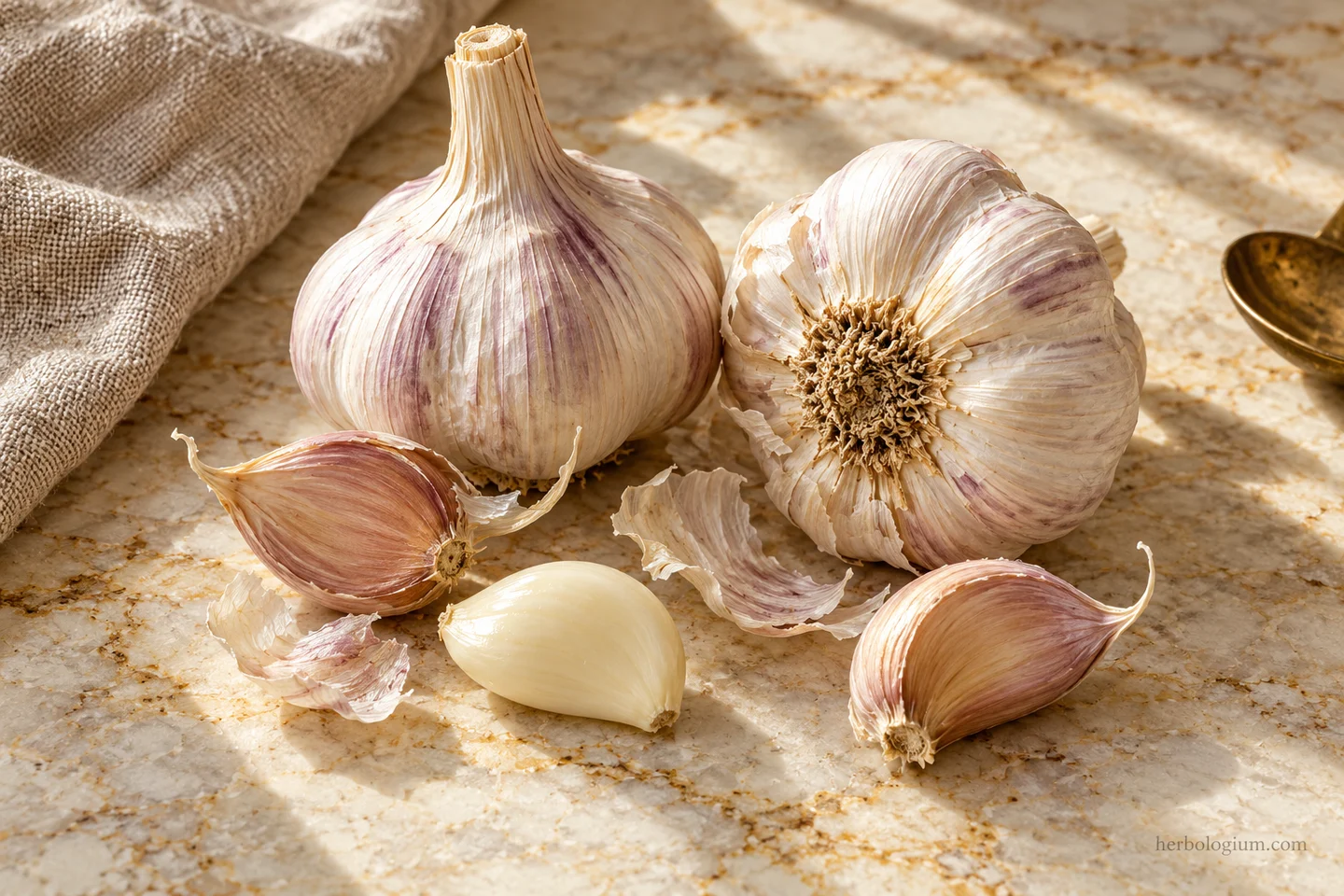
Garlic — imagined ingredient study · OpenAI image generation · Herbologium art direction · AI-generated decorative artwork. Original AI-generated ingredient illustration, made for Herbologium with Taj Mahal quartzite, flax linen and soft natural-light styling. Not a photograph, botanical identification guide, or documentation of a historical custom. The domain mark identifies the collection; no human photographer is claimed. No blanket reuse license is stated. Source: https://herbologium.com/botanical-illustrations.json
A bulb made of cloves
Garlic is Allium sativum, in the family Amaryllidaceae. Kew places its native range in Central Asia to northeastern Iran. A native-range statement describes the botanical record; it is not a complete account of domestication, human movement, or the many cuisines that later made garlic familiar. Those histories need their own evidence rather than being read directly from a modern plant distribution.
The bulb contains separate cloves, enclosed by papery coverings that may be white, purple, or pink. Gardeners commonly grow garlic by planting those cloves. University of Minnesota Extension explains this structure and method in guidance written for Minnesota gardens. Its planting calendar belongs to that setting; the connection between a stored clove and a new plant is the broader botanical observation.
Sources: Royal Botanic Gardens, Kew (n.d.) ↗ ; University of Minnesota Extension (n.d.) ↗
The verbs carry the recipe
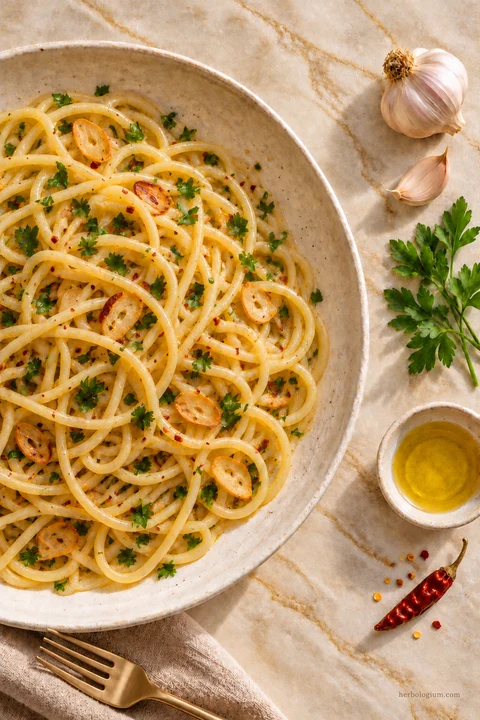
A garlic entry in a family recipe is often only a few words long. The verbs hold much of the missing detail: peel, slice, chop, crush, roast, or sauté. University of Minnesota's food guidance describes garlic in dressings, soups, and roasted or sautéed preparations, and recommends selecting firm, dry bulbs. These are concrete kitchen observations, distinct from a claim about treating illness.
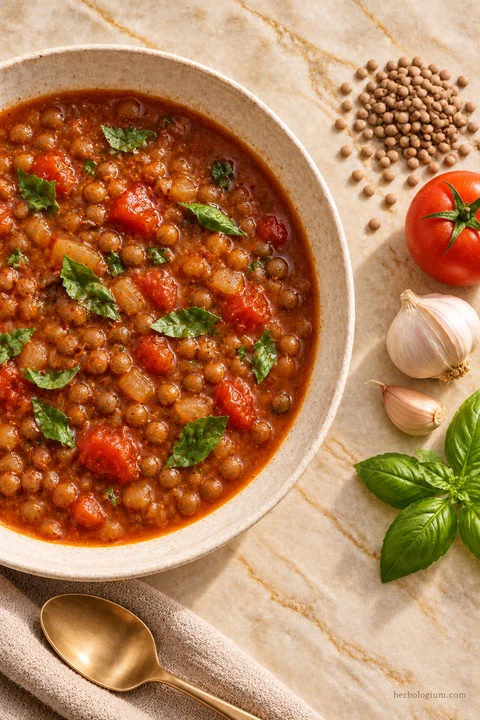
The lentil soup card contains a complete contemporary editorial formula with tomato and basil. It is independently composed, AI-assisted and not independently kitchen-tested. Its ingredients do not establish an ancient recipe or continuity with a remembered family soup. The botanical, archaeological and cooking records retain their separate sources.
Sources: University of Minnesota Extension, Real Life, Good Food (n.d.) ↗ ; NHLBI / Nutrition.gov (n.d.) ↗
Cutting changes the chemistry
Garlic chemistry helps explain why preparation deserves attention. When tissue is disrupted, the enzyme alliinase can act on alliin to generate allicin and related sulfur compounds. Lawson and Gardner's 2005 study characterized the composition, stability, and bioavailability of garlic products intended for a clinical trial. A raw clove, a powder, and an aged extract are therefore not automatically equivalent research materials.
This is a reason to read the methods carefully. Detecting a compound, measuring its formation, or comparing products establishes a chemical fact under particular conditions. Those measurements do not, on their own, show that a preparation prevents disease or that a more pungent dish produces a larger health benefit.
An individual trial in a larger record
A 2007 randomized trial assigned 192 adults with moderately elevated cholesterol to raw garlic, a powdered supplement, an aged extract supplement, or placebo for six months. None of the tested garlic preparations significantly reduced LDL cholesterol. That result belongs to those preparations, participants, and measurements.
The wider evidence is more mixed than one trial can express. NCCIH's 2025 overview reports that garlic supplements may reduce total and LDL cholesterol to a small degree in people with high levels. Reading the trial alongside that overview preserves both findings: a well-described null result and a cautious synthesis across studies. Neither establishes that every garlic product or ordinary recipe has the same effect.
Sources: Gardner, C. D., Lawson, L. D., Block, E., Chatterjee, L. M., Kiazand, A., Balise, R. R., & Kraemer, H. C. (2007) ↗ ; National Center for Complementary and Integrative Health (2025) ↗
A clove carried for protection
A 2023 USC folklore archive entry records one informant's family teaching from Veracruz: carrying a garlic clove in a pocket in crowded settings to protect against mal ojo. The account documents a remembered protective custom. It does not measure how widespread that custom is or establish supernatural protection. Its value here is specific and human: it shows how an everyday ingredient can also become an object of care, instruction, and inherited belief.
Sources: Randy Esparza, USC Digital Folklore Archives (2023) ↗
KEEP THE FOOTNOTES
Sources & further reading
Royal Botanic Gardens, Kew · n.d.
Botanical identity.
University of Minnesota Extension · n.d.
Supports bulb and clove structure and propagation using cloves. Planting calendars and cultivar advice are specific to Minnesota conditions.
- 03Garlic
University of Minnesota Extension, Real Life, Good Food · n.d.
Used for selecting firm, dry bulbs and documented culinary forms and uses, including roasting, sautéing, dressings, and soup. The page's broader health and insect-repellent assertions are not used.
NHLBI / Nutrition.gov · n.d.
Original source recipe. Herbologium retains an original editorial description, source link and plant connections; the complete preparation remains with the credited publisher.
Lawson, L. D., & Gardner, C. D. · 2005
Journal of Agricultural and Food Chemistry, 53(16), 6254–6261. Supports the role of alliinase in generating allicin and related thiosulfinates after garlic tissue is disrupted, and chemical differences among preparations. Product characterization and bioavailability do not demonstrate a medical outcome. The DOI ends with a literal plus sign, encoded in this URL.
Gardner, C. D., Lawson, L. D., Block, E., Chatterjee, L. M., Kiazand, A., Balise, R. R., & Kraemer, H. C. · 2007
Archives of Internal Medicine, 167(4), 346–353. Trial of 192 adults comparing raw garlic, a powdered supplement, an aged extract supplement, and placebo over six months. None of the tested garlic preparations significantly reduced LDL cholesterol. The result concerns these products, participants, and outcomes.
- 07Garlic
National Center for Complementary and Integrative Health · 2025
Updated February 2025. Official synthesis reports that garlic supplements may reduce total and LDL cholesterol to a small degree in people with high levels. Included to place the individual null trial in a wider evidence context. This is not evidence that every preparation produces the same result.
Randy Esparza, USC Digital Folklore Archives · 2023
One informant's account of family teaching; not a regional prevalence study.
Something to add or correct? Prepare a note for the collection.
Your notes on this card
What worked, what you changed, what you want to remember. Private to this browser.
BRING IT TO THE TABLE
Cook with garlic.
All 25 connected recipes →An ingredient across tables
Find this plant in the Atlas.
These places connect through recipes or documented accounts using this plant. They do not describe its native range or place of domestication.