Mediterranean food connections
Herbs, grains, and vegetables
Tabouleh’s publisher supplies a Mediterranean category; the baba ganoush source also names a Mediterranean context. Compare their ingredient lists and preparation methods through the connected plant profiles.
From the kitchen
Something to bring to your table.
 Recipe
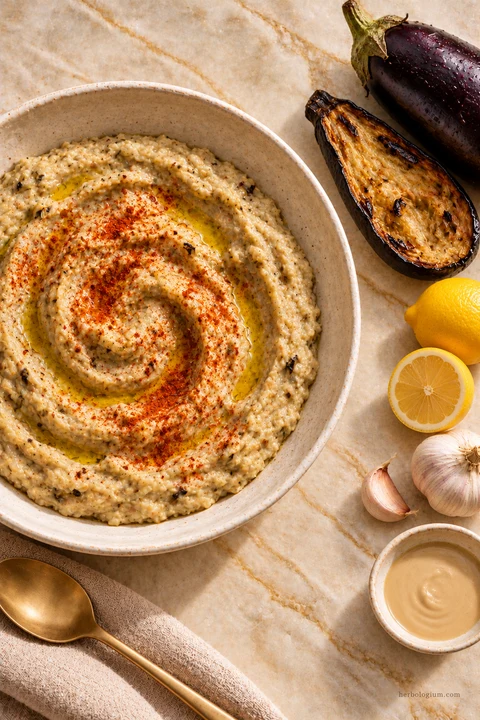
Baba ganoush
The eggplant is fully roasted before its flesh is blended with tahini, citrus and garlic.
AI-generated illustration: OpenAI image generation · Herbologium art direction. Baba ganoush — AI-generated serving illustration. https://herbologium.com/recipe-illustrations.json · AI-generated illustration; no blanket reuse license stated · AI-generated food scene refined to use Taj Mahal quartzite, flax linen and brushed brass, with a small visible herbologium.com mark. Separate portrait and landscape compositions; responsive sizes and JPEG/WebP encoding with embedded AI provenance.
Wikibooks describes Middle Eastern and Mediterranean culinary contexts. Neither label is an exclusive national origin.
 Recipe
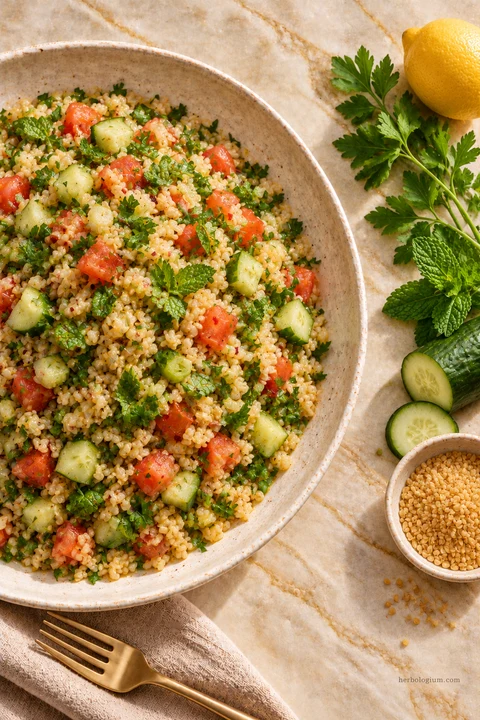
Tabouleh
Bulgur absorbs hot water before it is combined with herbs, vegetables and a lemon dressing. The source does not identify the mint species.
AI-generated illustration: OpenAI image generation · Herbologium art direction. Tabouleh — AI-generated serving illustration. https://herbologium.com/recipe-illustrations.json · AI-generated illustration; no blanket reuse license stated · AI-generated food scene refined to use Taj Mahal quartzite, flax linen and brushed brass, with a small visible herbologium.com mark. Separate portrait and landscape compositions; responsive sizes and JPEG/WebP encoding with embedded AI provenance.
The source uses a Mediterranean category. A more specific geographical history is not supplied by that classification.
Meet the ingredients
Plants beside these readings.
Ingredients and plants in the selected sources; their presence here does not establish a native range or origin.
People, practice & time
Stay for the story.
Historical accounts are still to be added to this collection. The recipe sources above establish its present geographical connections.
THE THINGS WE PASS ON
Keep these recipes in a booklet.
Gather public recipes, regional folios and your family cards into a collection to print. Keep the original words, scans, names and stories together; add cooking notes when you want them.
Begin with a sourced public recipe or regional folio, or add your own family recipes and stories.
Keep the source beside the place.
Mediterranean is a broad culinary label here, not a political boundary or proof of a shared historical route. Country-specific claims require more specific sources.
Wikibooks contributors (see page history) · Cookbook:Baba Ganoush ↗ https://en.wikibooks.org/wiki/Cookbook%3ABaba_Ganoush
joel-maxuel · Tabouleh ↗ https://publicdomainrecipes.com/tabouleh/
Suggest a source correction →Follow your curiosity
A few paths into the collection.
One ingredient, many tables
Follow maize from a documented food system to a separately sourced polenta recipe. A comparison of uses, not a claimed route of transmission.
Follow this trail →02 · 3 stopsBreads and grains
Compare a raised loaf, a soft oatcake and a flatbread through their source recipes.
Follow this trail →03 · 4 stopsThe many preparations of lentils
Three source-named versions, with their different ingredients and methods kept intact.
Follow this trail →04 · 3 stopsPlants in celebration and remembrance
Keep a meal, a commemoration and a literary account distinct while following their plants.
Follow this trail →05 · 3 stopsFood traditions across places
Read the kimjang account, then examine a separate contemporary fresh cabbage preparation without treating the two as the same recipe.
Follow this trail →