Focaccia
A leavened bread for the table
This Wikibooks formula uses two yeast mixtures and several rises before baking.
3–4 hours (source) · One 11 × 14 inch loaf
Reported source details; omitted times or yields remain unreported.Recipe source: Wikibooks contributors (see page history)
Not independently kitchen-tested by Herbologium.

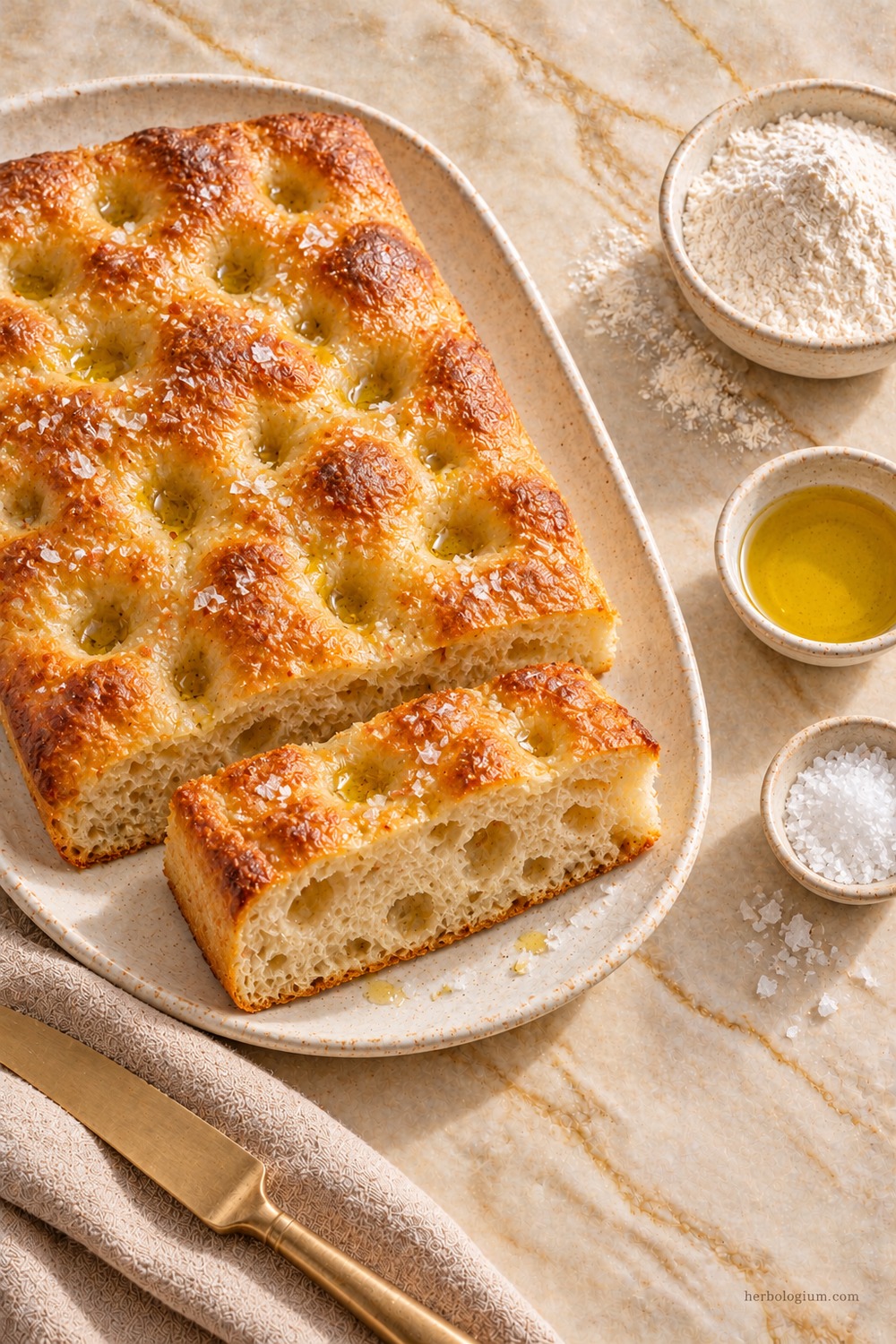
AI-generated illustration: OpenAI image generation · Herbologium art direction. Focaccia — AI-generated serving illustration. https://herbologium.com/recipe-illustrations.json · AI-generated illustration; no blanket reuse license stated · AI-generated food scene refined to use Taj Mahal quartzite, flax linen and brushed brass, with a small visible herbologium.com mark. Separate portrait and landscape compositions; responsive sizes and JPEG/WebP encoding with embedded AI provenance.
Gather
- 2 teaspoons (8 g) active dry yeast (non-instant)
- 1½ cups (355.5 g) warm water (approximately 110°F / 43°C)
- 4 cups (500 g) unbleached all-purpose flour
- 5 tablespoons (67.5 g) extra-virgin olive oil
- 3 teaspoons (18 g) sea salt
Meet the plants
Make
- 01
Sprinkle one teaspoon of the yeast over ½ cup of the water in a medium bowl. Stir to mix, and let stand 10 minutes. Stir in ¾ cup flour, cover tightly with plastic and let rise in warm place until doubled, about 45 minutes.
- 02
In a large bowl, sprinkle the remaining teaspoon of yeast over 1 cup of warm water, mix and let stand 10 minutes. Add the first yeast mixture (now risen) along with 3 tablespoons of olive oil and 2 teaspoons of salt, mix well. Add the remaining flour gradually, mixing well after each addition until well incorporated.
- 03
On a lightly floured work surface, turn the dough out and knead until soft, about 10 minutes.
- 04
Place the dough in a lightly oiled bowl, cover tightly and let rise in warm place until doubled, about 1 ½ hours.
- 05
Oil an 11" x 14" (28 cm x 36 cm) baking pan and turn the risen dough out onto the pan, flattening it out to the edges. If the dough springs back too much to cover the pan, allow it to rest for 10 minutes before resuming. Cover with a clean towel and let rise 45 minutes to an hour.
- 06
Preheat oven to 425 °F (220 °C). Remove towel and press indentations into the dough with your fingertips, then drizzle with the remaining 2 tablespoons of olive oil, sprinkle with sea salt and place pan in oven. Bake 20 to 25 minutes, or until the top is golden.
- 07
Remove the focaccia from the pan as soon as it is out of the oven and let cool on a rack before serving.
Adapted from Cookbook:Focaccia I, Wikibooks contributors, revision 4658422. CC BY-SA 4.0. Editorially reviewed against the cited source. Not independently kitchen-tested by Herbologium. Timings and yields are those reported by the source; omitted values remain unreported.
Keep what you learn
Your kitchen notes
Cooking dates, substitutions, and things to try next time. Kept privately in this browser.
FROM THE STOVE TO THE BOX
Your times at the table.
A date, a substitution, a small discovery to bring to the next meal.
Opening your cooking notes…
Your notes on this card
What worked, what you changed, what you want to remember. Private to this browser.
Food & place
Follow this recipe into the Atlas.
- Source recipe version
Wikibooks files this formula under Italian recipes. The connection describes this source version, not a single origin for all flatbreads.
Why this connection?
FOLLOW AN INGREDIENT
From the pot to the collection.
Meet the plants
Wheat Triticum L. · genus →Places in the pantry
Accounts in our Atlas that share these ingredients.
Explore the Atlas →Bring a plant to the study table →THE THINGS WE PASS ON
Keep this recipe in a booklet.
Gather public recipes, regional folios and your family cards into a collection to print. Keep the original words, scans, names and stories together; add cooking notes when you want them.
Begin with a sourced public recipe or regional folio, or add your own family recipes and stories.
Keep the source beside the recipe
Sources & presentation
Collection updated: October 17, 2026
Wikibooks contributors (see page history). (2026). Cookbook:Focaccia I.
https://en.wikibooks.org/wiki/Cookbook%3AFocaccia_I
Reviewed version: https://en.wikibooks.org/w/index.php?title=Cookbook%3AFocaccia%20I&oldid=4658422
CC BY-SA 4.0 · https://creativecommons.org/licenses/by-sa/4.0/
Changes: Ingredient and procedure sections adapted from the linked revision; wiki formatting and glossary links removed. Introductory text, images, nutrition estimates and optional storage guidance omitted. Herbologium supplies the title, summary and connected readings. The recipe adaptation is available under CC BY-SA 4.0. The source ingredient table is presented as a list using its stated volume and weight values.
Editorially reviewed against the cited source. Not independently kitchen-tested by Herbologium. Timings and yields are those reported by the source; omitted values remain unreported.
KEEP THE MAKER
Wikibooks contributors (see page history) · 2026
CC BY-SA 4.0
Editorially reviewed against the cited source. Not independently kitchen-tested by Herbologium. Timings and yields are those reported by the source; omitted values remain unreported.
What changed in this presentation?
Ingredient and procedure sections adapted from the linked revision; wiki formatting and glossary links removed. Introductory text, images, nutrition estimates and optional storage guidance omitted. Herbologium supplies the title, summary and connected readings. The recipe adaptation is available under CC BY-SA 4.0. The source ingredient table is presented as a list using its stated volume and weight values.
About this recipe and its connections
The recipe and its maker
This Wikibooks formula uses two yeast mixtures and several rises before baking.
This is Wikibooks contributors (see page history)’s version, published in 2026. Editorially reviewed against the cited source. Not independently kitchen-tested by Herbologium. Timings and yields are those reported by the source; omitted values remain unreported.
Wikibooks contributors (see page history)A thread to follow
The ingredient links lead to botanical profiles and, where available, separately sourced stories, places and research. A shared ingredient does not transfer the claims of one reading to another.
Something to add or correct? Prepare a note for the collection.