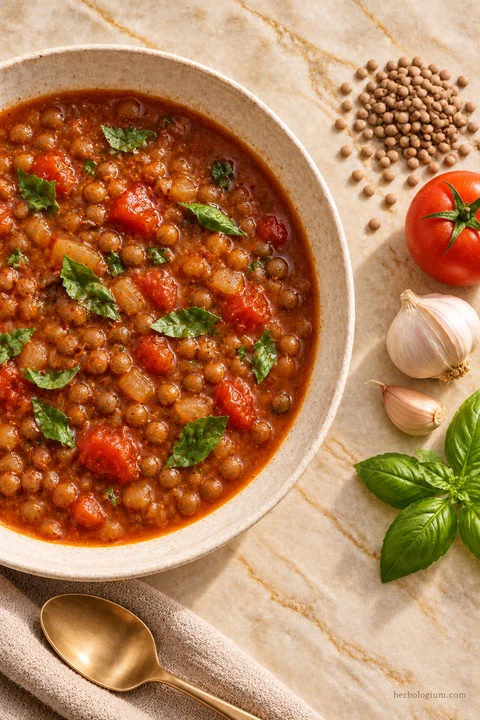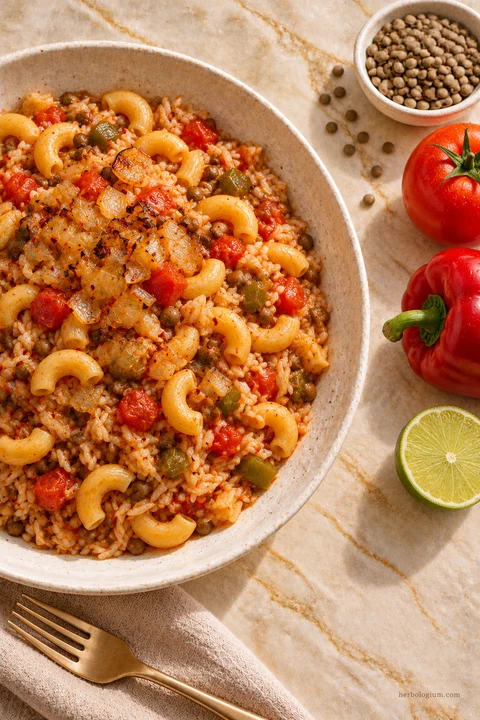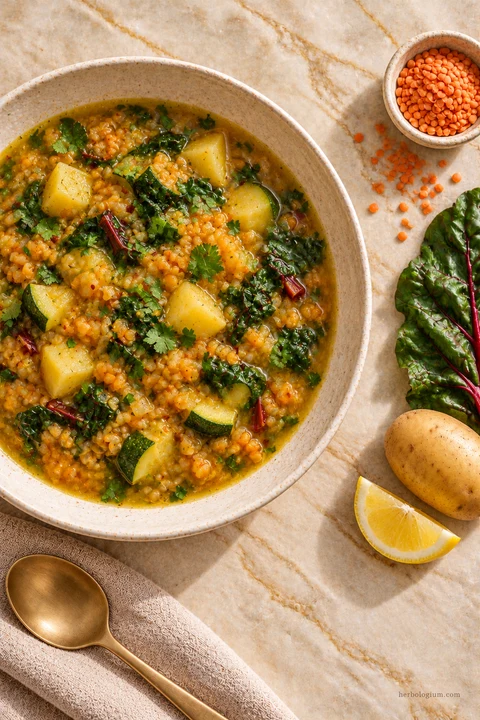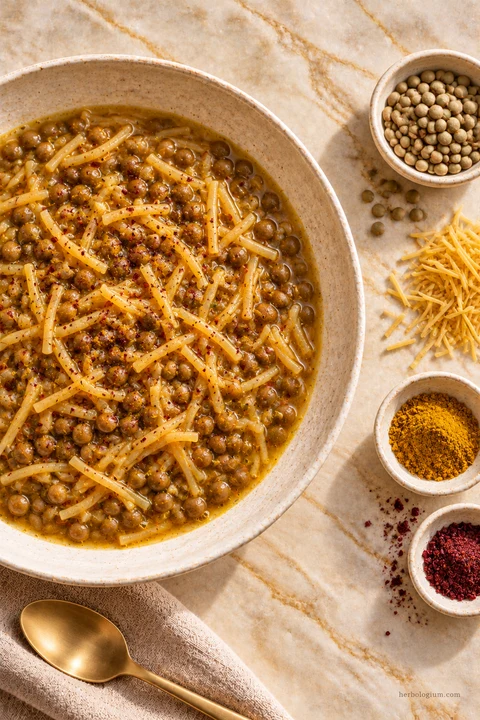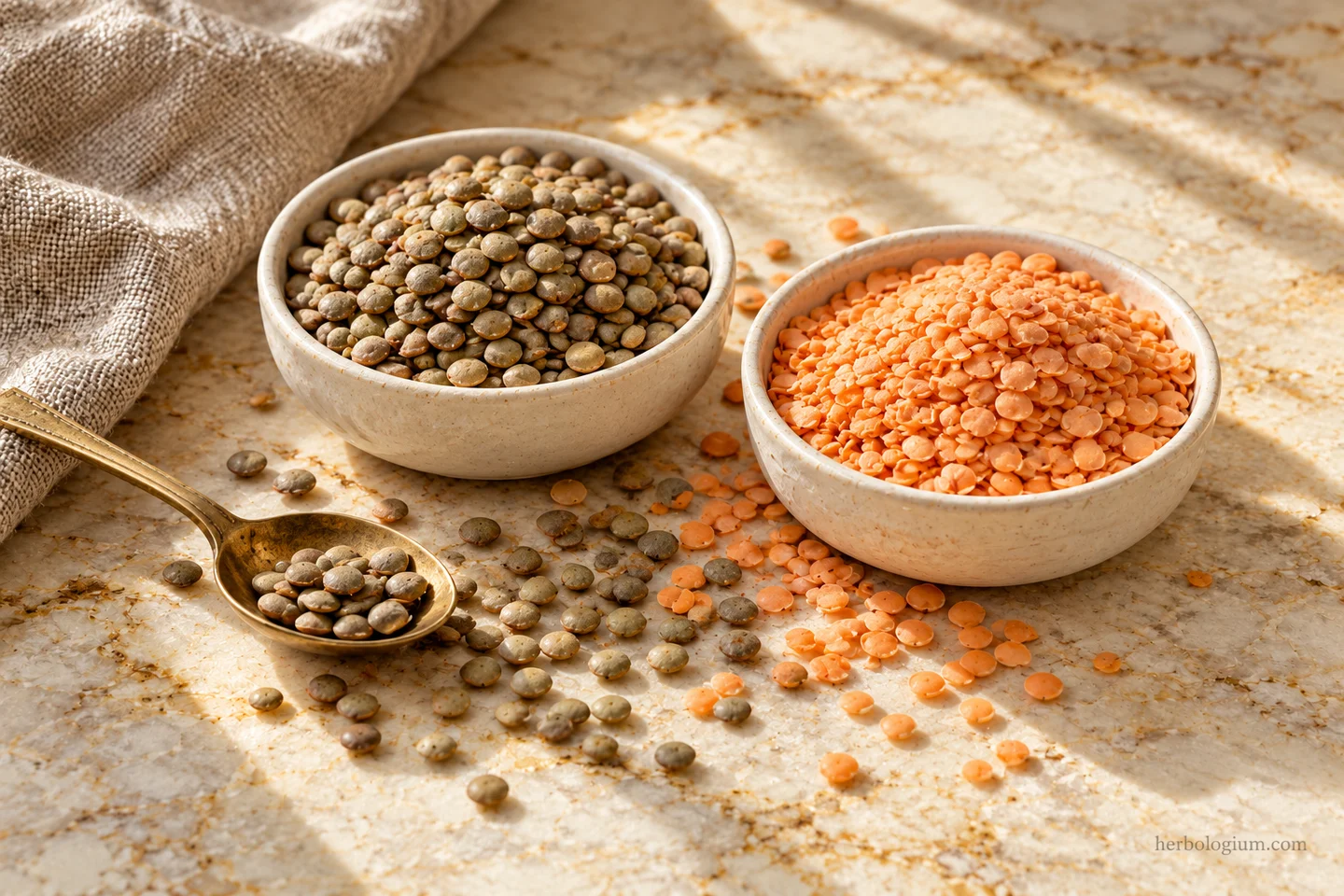
Lentil — imagined ingredient study · OpenAI image generation · Herbologium art direction · AI-generated decorative artwork. Original AI-generated ingredient illustration, made for Herbologium with Taj Mahal quartzite, flax linen and soft natural-light styling. Not a photograph, botanical identification guide, or documentation of a historical custom. The domain mark identifies the collection; no human photographer is claimed. No blanket reuse license is stated. Source: https://herbologium.com/botanical-illustrations.json
The name on the seed record
Kew's accepted name for the cultivated lentil is Vicia lens, in the pea family, Fabaceae. Lens culinaris remains a familiar synonym in food writing and scientific research. Retaining that older name in the record makes the literature easier to follow. Archaeological reports may identify a specimen only as Lens sp.; that is a more limited identification and should remain visible when its evidence enters the story.
The part we cook is the seed. Whole and split lentils behave differently in a pot, so a recipe should identify which it uses. Iowa State Extension recommends sorting and rinsing dried lentils and notes that they can cook without a preliminary soak. Split lentils cook more quickly, while older lentils may take longer. These distinctions are more useful to a cook than treating every package as though it had one fixed cooking time.
Sources: Royal Botanic Gardens, Kew (n.d.) ↗ ; Iowa State University Extension and Outreach, Spend Smart. Eat Smart. (n.d.) ↗ ; Caracuta, V., Vardi, J., Paz, Y., & Boaretto, E. (2017) ↗
A soup with a documented source
The lentil soup source card links to the contemporary NHLBI recipe shared by Nutrition.gov. Its full instructions remain with the publisher; no smaller-batch adaptation is presented here. The private recipe box can hold future observations about texture, cooking time, substitutions, and who made a preparation, provided those observations are recorded when they actually happen.
This recipe is not presented as a reconstruction of a prehistoric meal. A charred seed can reveal that a plant was present in an archaeological context; it usually cannot give us the proportions, seasoning, liquid, or household practice behind a bowl of soup. The distance between a seed and a recipe is part of the story.
Sources: NHLBI / Nutrition.gov (n.d.) ↗ ; Snir, A., Nadel, D., Groman-Yaroslavski, I., Melamed, Y., Sternberg, M., Bar-Yosef, O., & Weiss, E. (2015) ↗ ; Caracuta, V., Vardi, J., Paz, Y., & Boaretto, E. (2017) ↗
Three places, three kinds of evidence
At Ohalo II, a hunter-gatherer campsite on the southwestern shore of the Sea of Galilee, a plant assemblage about 23,000 years old includes wild progenitors of lentil. The cited paper discusses possible experimental cultivation of cereals; that argument cannot be transferred to lentils simply because their remains occur at the same site.
At Gusir Höyük in southeastern Türkiye, carbon-isotope measurements offer a different question. Changes in a small sample of morphologically wild lentils from the early Pre-Pottery Neolithic B may reflect cultivation, but gathering from different habitats is another explanation. The relevant period is approximately 8550–8350 BCE. The study does not establish a securely domesticated lentil form.
At Ahihud in Lower Galilee, storage contexts contained legumes including lentils identified at genus level. The authors interpret the assemblage within early legume farming. The broader dated range is approximately 8300–7950 BCE. These sites are separate observations with different uncertainties; joining them with a travel arrow would imply a route the evidence has not demonstrated.
Sources: Snir, A., Nadel, D., Groman-Yaroslavski, I., Melamed, Y., Sternberg, M., Bar-Yosef, O., & Weiss, E. (2015) ↗ ; Kabukcu, Ceren (2023) ↗ ; Caracuta, V., Vardi, J., Paz, Y., & Boaretto, E. (2017) ↗
Nutrition without a universal prescription
Lentils supply protein, fiber, and iron. Research can also ask narrower questions about particular meals. A 2018 randomized crossover study used two groups of 24 healthy adults to compare rice or instant potato with mixtures in which lentils supplied half the available carbohydrate. All three tested potato–lentil mixtures reduced the measured post-meal glucose response relative to potato alone; results with rice varied by lentil type.
That was an acute feeding experiment, not proof of long-term disease prevention or a personal diet determined by ancestry. The archaeological and nutritional records become more useful when their questions remain precise: what was stored at this site, what did this meal change over the next few hours, and what did this household choose to cook? No single answer has to stand in for all the others.
Sources: Iowa State University Extension and Outreach, Spend Smart. Eat Smart. (n.d.) ↗ ; Moravek, D., Duncan, A. M., VanderSluis, L. B., Turkstra, S. J., Rogers, E. J., Wilson, J. M., Hawke, A., & Ramdath, D. D. (2018) ↗
KEEP THE FOOTNOTES
Sources & further reading
Royal Botanic Gardens, Kew · n.d.
Accepted name; Lens culinaris is a familiar synonym.
- 02Lentils
Iowa State University Extension and Outreach, Spend Smart. Eat Smart. · n.d.
Supports sorting and rinsing, cooking without a preliminary soak, faster cooking of split lentils, longer cooking of older lentils, and the presence of protein, fiber, and iron. The page's assertion about salt preventing softening is not used. Timing is treated as variable.
NHLBI / Nutrition.gov · n.d.
Original source recipe. Herbologium retains an original editorial description, source link and plant connections; the complete preparation remains with the credited publisher.
Snir, A., Nadel, D., Groman-Yaroslavski, I., Melamed, Y., Sternberg, M., Bar-Yosef, O., & Weiss, E. · 2015
PLOS ONE, 10(7), e0131422. Ohalo II, on the southwestern shore of the Sea of Galilee, dates to about 23,000 years ago. Its plant assemblage includes wild progenitors of lentil. The paper's argument for experimental cultivation concerns cereals; it does not establish lentil cultivation. Exact site coordinates were not verified for the map.
Kabukcu, Ceren · 2023
Vegetation History and Archaeobotany, 32, 533–543. Early Pre-Pottery Neolithic B samples date to 10,500–10,300 calibrated years BP, approximately 8550–8350 BCE. Carbon-isotope differences in a small sample of morphologically wild lentils may reflect cultivation or gathering from different habitats. Domestication is not demonstrated. The map coordinate is independently sourced from lentilGusirLocation.
Caracuta, V., Vardi, J., Paz, Y., & Boaretto, E. · 2017
PLOS ONE, 12(5), e0177859. Ahihud, in the Bet ha-Kerem valley of Lower Galilee, has stored legumes including lentils identified as Lens sp. A broad range of individual calibrated dates is about 10,250–9900 cal BP, approximately 8300–7950 BCE; it is not a single exact occupation year. The authors interpret the assemblage as early legume farming. The remains do not by themselves establish species-level identification, a domesticated seed form, a trade route, or a recipe. Exact archaeological site coordinates were not verified for the map.
Moravek, D., Duncan, A. M., VanderSluis, L. B., Turkstra, S. J., Rogers, E. J., Wilson, J. M., Hawke, A., & Ramdath, D. D. · 2018
The Journal of Nutrition, 148(4), 535–541. Two groups of 24 healthy adults compared rice or instant potato with mixtures in which lentils supplied half the available carbohydrate. All three potato–lentil mixtures reduced the measured glucose response relative to potato alone. Rice findings differed by lentil type. An acute response does not establish chronic disease prevention or an individualized dietary prescription.
Something to add or correct? Prepare a note for the collection.
Your notes on this card
What worked, what you changed, what you want to remember. Private to this browser.
BRING IT TO THE TABLE
Cook with lentil.
All 6 connected recipes →An ingredient across tables
Find this plant in the Atlas.
These places connect through recipes or documented accounts using this plant. They do not describe its native range or place of domestication.
See these connections on the map →